Miss Independence Pies
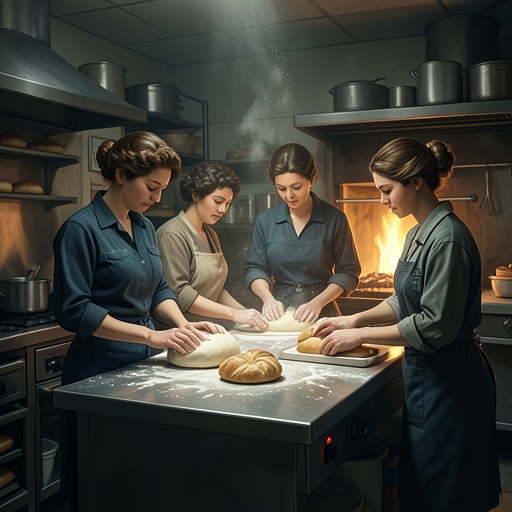
Jacob's LadderMiss Independence Pies is both a working bakery and a livelihood project: founded with a Santo Ignacio City Council loan to provide jobs for women affected by domestic violence, it offers Jacob Livingston a place to put his skills to use and gives its employees a practical route toward greater independence. Its flour-dusted worktables, commercial range, and repeated tasks make the shop more than a business setting. They give the story a concrete image of work as shared support: difficult circumstances are not erased, but people gather, plan, and make something together.
Purpose and Identity
The shop’s name carries an image beyond the pies it sells. When Mary Catherine Jensen removes her cardigan, Jacob sees a connection between the name and wartime posters of women rolling up their sleeves to do work traditionally assigned to men. This is Jacob’s interpretation of the image, not a stated account of the shop’s official naming. Still, it suits a business organized around women’s work and the possibility of earning a life less dependent on an abuser.
The bakery was originally funded by a loan from the Santo Ignacio City Council and intended to provide employment for female victims of domestic violence. Daniel later asks Jacob how he ended up working in a business with that purpose. Jacob is skeptical that wages alone can make someone financially independent; Daniel points out that other supports—including subsidized housing, Medicaid, and WIC—can make that goal more realistic. The exchange clarifies the shop’s place within a broader support network: paid work matters, but the path out of financial dependence may also require assistance beyond the workplace.
Jacob Joins the Bakery
Jacob’s arrival in St. Nacho’s is unplanned, but he comes to see the move as useful when he becomes Miss Independence Pies’ newest employee. He has already been working for nearly three hours when he announces the news, and JT’s surprised response identifies the shop through its owner, Mary Catherine Jensen. The bakery therefore enters Jacob’s life not as a distant cause but as immediate employment, where his training can be put to practical use.
His contribution soon reaches beyond routine production. Mary Catherine is developing savory pies and asks Jacob to help make the fillings. She has prepared beef and chicken with green chilies for empanadas, following his suggestions, and invites him to taste them. His experience becomes part of the shop’s experimentation: ideas are tested in the food itself, with the owner and employee working through a product together rather than leaving planning at the level of intention.
The ordinary work has a personal consequence for Jacob as well. He describes the bakery’s rhythm—mixing dough, preparing fillings, sheeting and cutting pastry, setting it in pans, and crimping the edges—as a familiar place where his hands can work while his mind finds peace. During one morning’s work with Mary Catherine, his sour mood eases as the hours pass. The repeated sequence is not presented as a cure for his troubles; its significance is smaller and more grounded. The work gives him a way to inhabit the present through skilled, shared activity.
Products, Planning, and Expansion
Mary Catherine’s ambitions extend beyond the bakery’s existing operation. She has her eye on adding savory pies to the business, and Jacob’s training proves useful as they draw up a plan based on what expansion would require. Later, a spreadsheet shows that Miss Independence Pies is doing better than most start-ups could expect. That favorable picture supports discussion of a retail space, but it does not mean every expansion plan has already been carried out.
The planning is specific and cautious. Jacob and Mary Catherine make drawings and write down ideas for the store, then discuss the menu and a staged approach: begin with a short list of items done well and broaden the range after seeing what customers respond to. The proposed method pairs ambition with restraint. Rather than treating growth as an automatic good, they consider how the business can learn from demand and expand its offerings in manageable steps.
A possible new site becomes part of that discussion when Mary Catherine learns that Roger’s Appliance is closing because its owner is retiring. Her real-estate agent has told her about the standalone building, which has an alley and loading dock and sits on Iglesias Road in a good location. The practical questions remain open: whether the whole operation would move, whether the current premises are leased, and whether baking would happen at one site while the other served as a retail space. Ken Ashton contributes to the process, visiting the building again, preparing rough numbers, and speaking with contractors. The evidence presents investigation and planning, not a completed move.
Ken is also connected to the project’s beginnings: Mary Catherine says that he was the person who gave her courage to enter the business. His involvement in assessing the possible building thus extends an earlier encouragement into concrete planning. At the same time, the shop’s own figures offer a basis for considering what comes next. The combination of personal support, financial estimates, and questions about production and retail keeps expansion tied to both relationships and workable logistics.
The Bakery as a Shared Workplace
The shop’s production is collective, with employees moving among distinct tasks. On one visit, Ken meets Jacob there, and Mary Catherine introduces him as the newest employee, noting that the others call him Yasha. Flour on Jacob’s hand interrupts his attempt to offer a handshake, a small sign of how quickly work has absorbed him into the bakery’s physical routine. Elsewhere, the staff load pies into boxes and carry them to a truck, showing the operation extending from preparation to delivery.
The employees have their own temperaments and frictions. Candace and Bianca bicker, while Muse watches for the dispute to become physical; another morning finds Candace and Bianca taking a pause together at the sink over coffee. Muse processes apples, and Analise prepares custard filling for pecan pies. These details give the bakery a social life alongside its production line: conflict and reconciliation are present, but so are separate responsibilities and the need to keep the work moving.
At a later gathering, the women are already waiting on the doorstep when the group reaches Miss Independence Pies. Mary Catherine unlocks the door, and they go inside to make pies. Once more, Bianca and Candace are together by the sink, Muse is processing apples, and Analise is making custard while Mary Catherine works on her business plan in the office. A gust of chilly air announces JT’s arrival in uniform; after he leaves, the group’s surprise and giggling give way to Bianca’s reminder that the pies still have to be finished before they can take Yasha shopping. The scene holds the bakery’s different functions in one frame: a place of labor, planning, friendship, and attention to Jacob’s needs.
Significance
Miss Independence Pies connects economic independence to the practical conditions that can make it possible. Its stated employment purpose addresses financial dependence, while Daniel’s reference to housing and public benefits makes clear that a job is part of a larger support system rather than a guarantee by itself. The business’s expansion plans likewise remain grounded in concrete questions—what to bake, where to produce it, how to sell it, and whether the numbers work.
For Jacob, the bakery provides both paid work and a restorative routine. For Mary Catherine, it is a business she has built with encouragement from Ken and is considering how to grow. For the employees, it is a shared workplace where individual tasks continue amid conflict, teasing, and mutual attention. The shop’s significance lies in keeping those dimensions together: its social purpose does not replace the labor of making and selling pies; it takes shape through that labor, one batch and one considered business decision at a time.